


Artist Profile: pixelshifter
Melbourne-based digital artist Scott Ritchie (aka pixelshifter) sits down with Sugar Glider Digital to reflect on the moments, influences and technologies that have shaped his practice.
This is part of a series of interviews with Sugar Glider Digital’s artists, where we explore artists’ practice and perspectives on digital art.
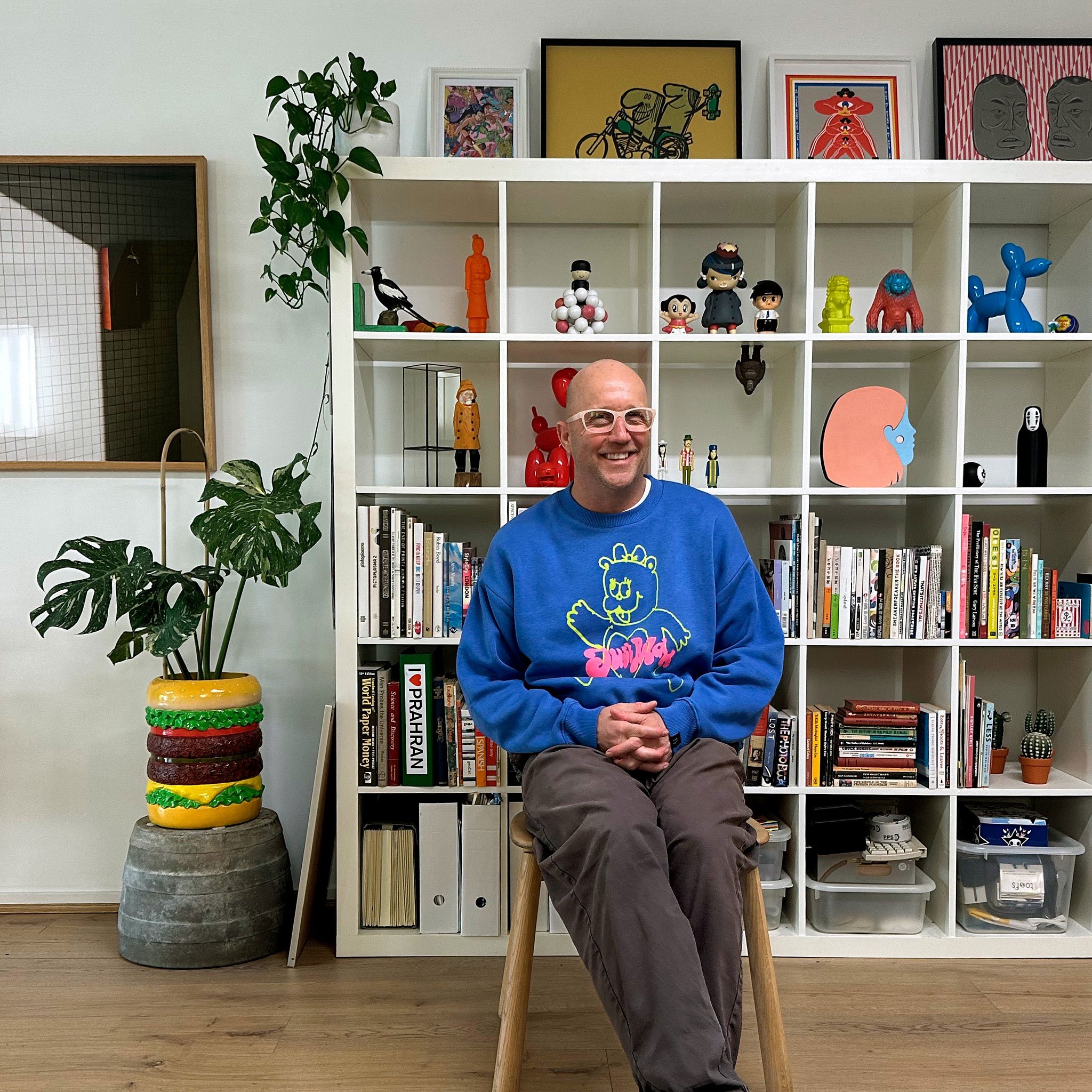
Image credit: Scott Ritchie
“As a digital artist, there’s an overwhelming abundance of tools available, and just “playing” with new software can trigger a stream of ideas.”
Hobart Floatation, 2025
1. Were there any pivotal moments or experiences that shaped your practice?
I can remember feeling a strong sense of awe at numerous times in my life in front of the big screen. A cinema 180 experience with my grandpa in the 70’s, the speeder bike chase scene in Return of the Jedi, my first IMAX experience and numerous raves in the mid 90’s where projected visuals became more common. Whilst not necessarily shaping my practice, they definitely formed a lasting attraction to large format screens.
Discovering other artists definitely helps to shift your thinking and encourages the mind to consider possibilities. Colour and light guru James Turrell still fascinates me, and early motion graphics gurus, GMUNK (Bradley G. Munkowitz) , Robert Seidel and Presstube (James Paterson) have influenced me greatly for many years, and still do.
2. What particular tools, materials, or techniques are central to your practice?
As a digital artist, there’s an overwhelming abundance of tools available, and just “playing” with new software can trigger a stream of ideas. This nerd gets a great deal of entertainment from pushing software limits to maybe yield unexpected or more subtle results. More recently, I’ve been experimenting with LiDAR scanning, Gaussian splatting and point-cloud workflows.
“Observation is key, so just spending time in nature to pay attention to natural forces and movement really provides me with inspiration. ”
3. Are there skills or techniques you’re currently working to develop?
Observation is key, so just spending time in nature to pay attention to natural forces and movement really provides me with inspiration. In trying to capture mesmerising animated loops, the close inspection of natural motion becomes endlessly fascinating. Maintaining a sense of “play” always helps to find the beautiful accidents.
Folds, 2025
4. How does exhibiting your work affect your practice?
It’s definitely encouraging, and quite exciting to see the end result at large scale. I always test artworks on a 4K TV, and sometime use a projector to get an idea of the larger size, but the work may sometimes end up on a screen far bigger than I may have had access to or imagined.
As the artist you become very familiar with the artwork, but it can still give you a sense of wonder and awe seeing it at a gigantic size. And in turn it may even inform you of something that might have been approached differently to suit the location or size of the final output.
Swelligance, 2025